

To be addicted is to be ‘physically or mentally dependent on a particular substance’. To be dependent is to be ‘unable to do without’. In a world of unlimited entertainment, dopamine on tap, and a rampant attention economy, addiction has evolved far beyond substance abuse. It has become acceptable to seek addiction externally, and when we inevitably find it, we feel empty and search for more. In reality, Life itself should be what we are addicted to.
Nietzsche’s concept of Amor Fati (love of fate) is to love what is—to make life itself what we desire rather than its vices. It is to not want things to be different, neither in the future, present nor past; not just bearing things, but loving them, no matter their state. “I want to learn more and more to see as beautiful what is necessary in things; then I shall be one of those who makes things beautiful. Amor fati: let that be my love henceforth!” To live a life worth living is to live a beautiful one, and beauty is in the eye of the beholder. Your life cannot be beautiful if you don’t deem it to be.
His idea of eternal recurrence asks: would you be willing to live your exact life over and over infinitely? If the answer is no, escapism has infected your life. If you knew you were writing the script of a movie you would have to watch for all eternity, how would you live? Addiction to life means stopping the resistance and loving it for what it is—being dependent on it to the point that you’d live it over and over again.
The rewards of life aren’t where real pleasure lies; it’s in the activities themselves that bear fruit to these rewards. Aristotle’s concept of Eudaimonia is all about searching for activity over outcome. Enjoy the act of doing more than what comes from doing. Pleasure is but a byproduct. The agency one feels when acting on something is what makes things so addictive.
Throughout my childhood, I was addicted to video games—specifically strategy and simulation. What made me so dependent on them was simple: the feeling of being in control kept me coming back. Tight feedback loops created every time I made a change in my in-game strategy and saw it play out in real time gave me the feeling that what I did actually means something. This is why power itself is so addictive, as well as substances that alter our perception of reality.
Life itself can be the most addictive of all—it is the most complex and has so many different ways to affect it. We don’t default to this because the feedback loops so tightly engineered in video games appear long and boring in real life, and our dopamine reliance is increasingly preyed on by accessible media. But with careful rewiring, it is possible to change this.
At our lowest points, we ask: why? Why would I even want to progress, or whatever society’s idea of progress is? What’s the meaning? Jean-Paul Sartre argues that we create meaning through our actions.
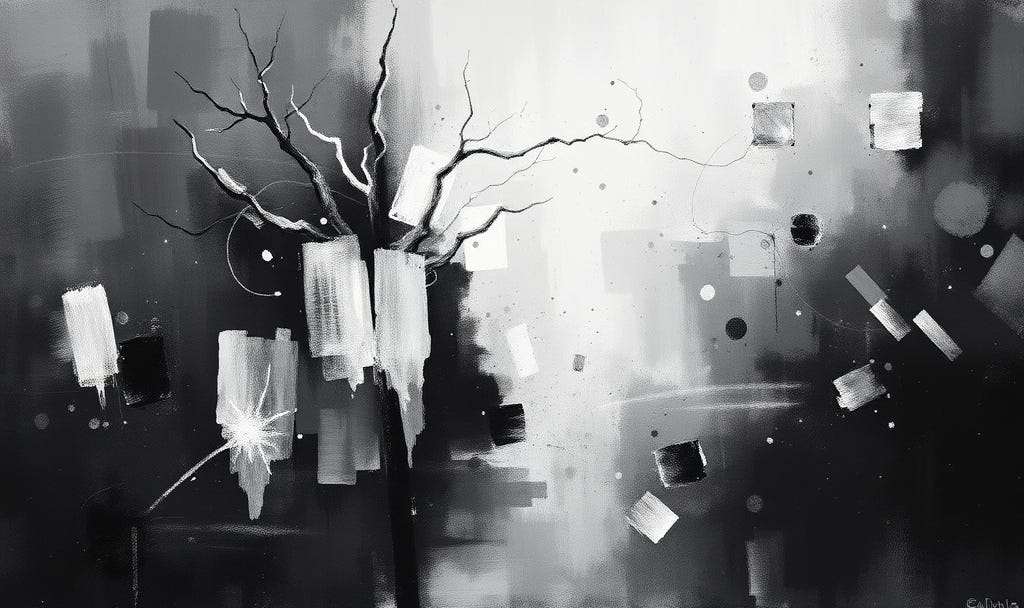
An analogy I’ve always loved is that of a canvas. At the start of life, each person has a canvas divided into various shapes, with the middle few already painted in different colours—a configuration unique to each person. This represents our uniqueness at birth and the circumstances we were born into. The painting doesn’t become complete until all the shapes have colour, which is done through our actions and choices from the inside out. You could choose to not see the meaning in it all, and your painting would end up a massive splash of grey. You can’t change what you’ve already painted, but at any point you can start painting a beautiful picture, with many colours and strokes, knowing that yours is totally unique. When painting each shape, the colours don’t make sense in isolation—that’s because you are in the process of constructing its meaning. The meaning of the painting is created by you, not searched for externally. You choose: the grey blob or the colourful kaleidoscope.
Flow theory supports this. Mihaly Csikszentmihalyi defines Flow as complete absorption where the activity itself is the reward. It is closely linked with autotelism—the act of doing something for its own sake. Someone with an autotelic personality turns anything into an engaging challenge. In his book Flow, Csikszentmihalyi describes a factory worker on an assembly line who turned an inherently boring job into an addictive game by forensically optimising his performance like an Olympic athlete. This not only made him flourish but thoroughly enjoy himself in the process. You can consciously make life addictive; doing so is all about perspective.
Intrinsic motivation will always beat external reward because externally, we always need more. But when searching for pleasure intrinsically in life’s activities, life has more to offer than we could ever want. It is always enough. When we adopt philosophies like creating more than we consume and gaining understanding to tighten our grip around the control we have over our lives, the video-game-like addiction that offers is priceless.
In Good Will Hunting, Will Hunting is a maths genius seemingly overwhelmed by his talent, seeking to find meaning in it and the responsibility it bore on him. He could do anything with his life, yet didn’t see the point. His deduction that climbing society’s ladder was equal to becoming a ‘lab rat’ was quickly shut down by his closest friend, Chuckie, who said if Will didn’t use his genius, he’d be very disappointed. The feeling Will had, I’m sure a lot of people can identify with. His realisation that previous events were not his fault—and didn’t need to be blockers to his future—combined with the understanding that he could make the ‘lab rat’ job mean whatever he wanted, allowed him to be at peace and move on.
Life is for the taking. It’s not just something to consume—it is a rich, infinite game worth playing and worth getting addicted to.